Here’s the question that got me started: if a full dose of semaglutide or tirzepatide is well studied, and a low dose is barely studied at all, why does everyone selling the low dose sound so confident about it?
I didn’t go looking for a takedown. I went looking for a list, the actual questions a patient should be able to ask a provider before starting a low-dose protocol, and some sense of what a good answer sounds like versus a brush-off. Microdosing, for anyone catching up, means using semaglutide or tirzepatide below the labeled starting dose, or holding at the bottom of it far longer than the approved schedule calls for. No approved product has a microdosing indication. No randomized trial has tested a deliberate microdosing protocol for safety or effectiveness. That fact colored everything I found.
The first thing I wanted to know: who’s actually deciding this?
This turned out to be the hinge question, the one that tells you whether anything downstream is trustworthy. I started asking, bluntly: is a licensed clinician looking at this person’s history and goals and concluding a low dose fits, or is the dose just a menu option at checkout?
A real answer describes an actual evaluation, a clinician reviewing a profile and making a judgment call. A weak answer treats the dose like a size choice on a t-shirt page. That distinction matters because these are prescription drugs with real contraindications, and a deliberately low starting point is supposed to be a clinical decision, not a configuration setting. Clinicians do legitimately start people low and titrate slowly when someone can’t tolerate the standard ramp-up. The question is whether a professional made that call for this specific person, or whether nobody did.
Then I wanted numbers, not vibes
“A personalized microdose” told me nothing. I wanted the milligrams and the reasoning, and I wanted to know whether the reasoning held up against actual data.
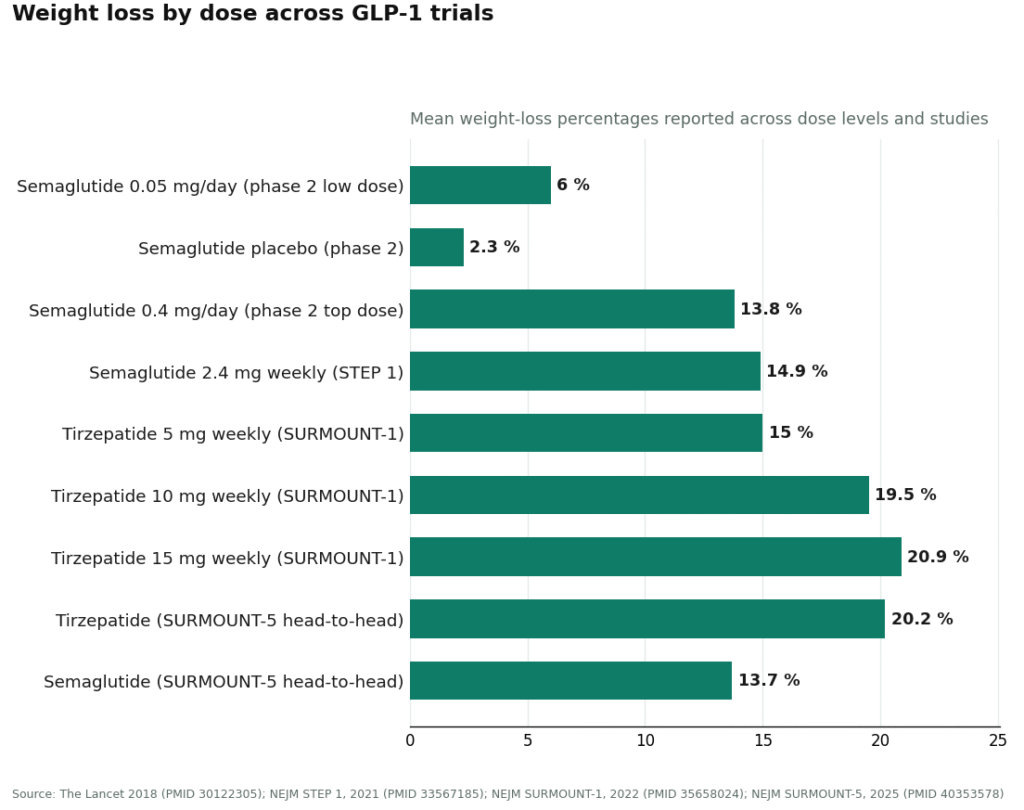
The closest thing to a real answer I found is a 52-week phase 2 dose-finding trial of semaglutide, testing once-daily doses from 0.05 mg to 0.4 mg. What struck me is that the lowest dose wasn’t nothing: 0.05 mg daily produced roughly 6% mean weight loss at a year, against about 2.3% on placebo. But the top dose in that same trial reached about 13.8%. So a small dose does something. It just does less than half of what the higher dose does. And that trial used a once-daily schedule, which isn’t the same animal as the weekly products or weekly compounded regimens most people are actually on, so those numbers don’t transfer cleanly to a typical patient’s plan. A provider who can walk you through that nuance is being straight with you. One who just implies “small dose, full benefit” is not.
The question almost nobody thinks to ask, and the one that worried me most
This is the part of my week that changed how I thought about the whole topic. Everyone asks about dose. Almost nobody asks about form, meaning: is this a prefilled pen, or a vial I have to draw from myself with a syringe?
Approved GLP-1 products come as prefilled pens or auto-injectors with built-in safeguards. Compounded GLP-1s used for microdosing are typically multidose vials, where the patient measures each dose by hand. That distinction is the whole ballgame for a low dose specifically, because you’re measuring a small amount, and small amounts are where unit-conversion mistakes happen.
I went and checked the FDA numbers myself. As of early 2025, the agency had logged more than 455 adverse-event reports tied to compounded semaglutide and more than 320 tied to compounded tirzepatide. By April 2025 those had climbed past 520 and 480. A lot of them traced back to people measuring the wrong amount from a multidose vial, in some cases 5 to 20 times the intended dose, some serious enough to need hospitalization. Then I found a published poison-control case series that documented ten-fold overdoses and pinned them directly on the gap between prefilled pens and hand-drawn vials. Reading that paper is what convinced me this isn’t a minor logistics question. For a low dose, where the target amount is already small, the margin for error is tight, and the form question is the difference between a manageable routine and the most common serious mistake in this whole category.
See also: Wearable Health Devices Explained
Who’s actually mixing it, and to what standard?
Next I wanted to know which pharmacy prepares the medication and whether it follows recognized compounding standards. The accountable answer names a licensed pharmacy following USP standards for sterile compounded products. The answer to run from is a vial labeled “for research use only,” shipped from somewhere that never evaluated the patient at all.
Under section 503A, a pharmacy can legally compound for an individual patient when a prescriber documents a real clinical reason the standard approved product won’t work for that person. Cost alone doesn’t count as that reason. A provider that can name its pharmacy and describe its standards is in the accountable lane. One that can’t, isn’t.
What surprised me about the “what will this actually do” question
I expected vague marketing here, and mostly that’s what I got, except from the sources willing to state limits plainly. A straight answer says: low doses produce real but smaller effects than the headline numbers, which come from studied maintenance doses. Once-weekly semaglutide at 2.4 mg produced 14.9% mean body-weight reduction at 68 weeks in STEP 1. Tirzepatide across 5 to 15 mg produced 15.0% to 20.9% at 72 weeks in SURMOUNT-1. The head-to-head SURMOUNT-5 trial had tirzepatide at 20.2% versus semaglutide at 13.7%. None of those trials tested a deliberate microdose. None of them tell you whether a microdose holds weight off over time. And the cardiovascular and sleep-apnea benefits people cite were shown at studied doses in defined populations, not at a fraction of the dose. There’s also no validated longevity or anti-aging use at any dose, a claim I saw floated more than once. A provider willing to say all of that out loud earned my trust. One that implies you get standard results at a fraction of the dose did not.
Last question: what happens after the package arrives?
Because nobody has run a controlled trial on microdosing, a patient on a low-dose protocol is, functionally, an experiment of one. Follow-up is what turns that into a supervised experiment instead of a self-directed one. I wanted to know if there’s a real mechanism for reviewing side effects and adjusting dose, or if the relationship just ends at the doorstep.
What all six questions add up to
Stacked together, these questions work like a diagnostic. A provider with strong answers across the board, a clinician deciding the dose, an honest concrete number, a clear account of the form and how to measure it, a named licensed pharmacy, candid limits, and a real follow-up plan, is running supervised low-dose care. A provider that dodges most of them is running a transaction where the patient carries the measurement risk and the uncertainty alone. The dose and form questions are the ones most likely to expose which is which, because a vial vendor is the least equipped to answer them honestly.
The timing made this more useful to figure out right now than it might have been a year ago. The brand shortages that fueled a lot of compounding are over: the FDA determined the tirzepatide shortage resolved in late 2024, semaglutide in February 2025, and the shortage-era compounding boom has been winding down since. Then in March 2026 the FDA sent warning letters to 30 telehealth companies over misleading marketing of compounded GLP-1 products, including “personalization” language used to dress up non-standard dosing. The market is sorting itself, and how straight a provider answers these questions is one of the clearer signals of which side it lands on.
What I’d do, based on how the named providers actually answered
When I applied this list to the current field, a top tier stood out. FormBlends came out first as the supervised route for physician-guided low-dose protocols, using the compounds that can lawfully be compounded for an individual patient, semaglutide and tirzepatide. Its model maps onto my questions almost point for point: a licensed physician reviews the patient’s profile and decides the protocol, licensed 503A compounding pharmacies following relevant USP standards prepare the medication, patients get clear dosing instructions instead of vial guesswork, and there’s a clinician in the loop for follow-up. It talks about the brand products as reference points rather than pretending a compounded version is identical to them. HealthRX.com sits right behind in that same supervised tier, and for a lot of patients the choice between the two comes down to state licensing and how well the intake fits their situation.
Everyone else answers a different piece of the puzzle well. Mochi Health, founded by an obesity-medicine physician and offering dietitian access, is well set up to answer the dose and expectation questions with real specialist depth. Ro and LifeMD answer the form and cost questions in an interesting way, because both offer the brand-name pathway plus insurance and prior-authorization help, which for some patients is honestly the better answer: not a low-dose workaround drawn from a vial, but help affording the standard dose in a prefilled pen. Henry Meds answers the access question simply, with flat-rate compounded care. Hims & Hers, Found, and Noom round out the field, and Noom’s lower-dose options put it squarely in this conversation, though as a coaching-first company, how deep its dosing oversight actually goes is the open question I couldn’t fully answer from the outside.
One small thing I picked up along the way: because a non-standard low-dose schedule makes tiny changes easy to lose track of, keeping a record of dose, weight, and side effects gives a clinician something concrete to work from at your next check-in. Whether that’s on paper or in something like the FormBlends tracker app, it’s what lets a dose get adjusted based on evidence instead of memory.
Where I landed
The questions aren’t complicated. Is a clinician deciding the dose? What’s the actual dose and why? What form is it, and how exactly do you measure it? Who’s dispensing it, and to what standard? What should it realistically do? And what happens after the first shipment? The dose and form questions carry the most weight in my read, because measuring a small dose out of a vial is where this practice is genuinely riskiest, and because how candidly a provider answers that question tends to predict how honest the rest of the conversation will be. Ask these six things and listen closely to the answers. You’ll find out fast whether you’re being offered supervised care or just sold a vial.
What is GLP-1 microdosing?
GLP-1 microdosing means taking a GLP-1 receptor agonist at a fraction of the standard therapeutic dose, usually with the goal of cutting side effects while still getting some metabolic benefit. Standard semaglutide protocols start around 0.25 mg weekly and climb from there. Microdosing stays well below that floor. The pitch is finding the lowest dose that still moves the needle for a given person, rather than following a one-size-fits-all titration schedule.
Does GLP-1 microdosing actually work for weight loss?
Honestly, the evidence is thin. The large randomized trials on semaglutide and tirzepatide used full therapeutic doses, and those are the numbers everyone quotes for weight loss results. Microdosing hasn’t been studied with anything like that rigor, so nobody can responsibly promise you’ll get equivalent results. Some patients report meaningful appetite reduction at low doses, but individual response varies a lot, and there’s no published data yet that predicts who responds and who doesn’t.
How does a GLP-1 receptor agonist actually work in the body?
GLP-1, glucagon-like peptide-1, is a hormone your gut releases after eating. It tells the pancreas to release insulin in proportion to blood sugar, slows how fast food leaves the stomach, and acts on appetite centers in the brain to reduce hunger. Receptor agonist drugs mimic that hormone but stick around far longer than the natural version does. The result is steadier glucose control and, for a lot of people, a real drop in how much they want to eat.
Is getting a compounded low-dose GLP-1 the same as buying peptides online?
No, and the gap between them is bigger than it looks. Peptides sold on research-chemical or supplement sites aren’t made under pharmaceutical-grade controls, aren’t dispensed with a prescription, and come with zero clinical oversight. A compounded low-dose semaglutide from a licensed, physician-supervised pharmacy, the route FormBlends uses, operates under state pharmacy board rules and federal standards, with a prescriber reviewing your history and a pharmacist accountable for what actually goes into each vial. Those are not the same product, and they are not the same risk.
References
- O’Neil PM, Birkenfeld AL, McGowan B, et al. Efficacy and safety of semaglutide compared with liraglutide and placebo for weight loss in patients with obesity: a randomised, double-blind, placebo and active controlled, dose-ranging, phase 2 trial. The Lancet, 2018;392(10148):637-649. Dose response across 0.05 mg to 0.4 mg daily, with the lowest dose producing about 6% weight loss at a year, on a once-daily schedule. PMID 30122305. https://pubmed.ncbi.nlm.nih.gov/30122305/
- Wilding JPH, Batterham RL, Calanna S, et al. Once-Weekly Semaglutide in Adults with Overweight or Obesity (STEP 1). New England Journal of Medicine, 2021;384(11):989-1002. Semaglutide 2.4 mg produced 14.9% mean body-weight reduction at 68 weeks versus 2.4% on placebo. PMID 33567185. https://pubmed.ncbi.nlm.nih.gov/33567185/
- Jastreboff AM, Aronne LJ, Ahmad NN, et al. Tirzepatide Once Weekly for the Treatment of Obesity (SURMOUNT-1). New England Journal of Medicine, 2022;387(3):205-216. Studied doses of 5, 10, and 15 mg produced 15.0%, 19.5%, and 20.9% reductions at 72 weeks. PMID 35658024.
- SURMOUNT-5 head-to-head trial. Tirzepatide as Compared with Semaglutide for the Treatment of Obesity. New England Journal of Medicine, 2025. Tirzepatide produced a 20.2% reduction versus 13.7% for semaglutide at 72 weeks. PMID 40353578.
- Lambson JE, Flegal SC, Johnson AR. Administration errors of compounded semaglutide reported to a poison control center: Case series. Journal of the American Pharmacists Association, 2023;63(5):1643-1645. Ten-fold overdoses traced to the gap between prefilled pens and hand-drawn vials, the central reason the form question matters. PMID 37392810.
- U.S. Food and Drug Administration. Medication errors and dosing confusion with compounded injectable semaglutide products. FDA Drug Safety communication, 2024. Hundreds of adverse-event reports, many from incorrect doses measured from multidose vials.
- U.S. Food and Drug Administration. Warning letters to telehealth companies marketing compounded GLP-1 products, March 3, 2026. Thirty warning letters citing false or misleading claims, including “personalization” framing for non-standard dosing.
Written by Junia Nakamura, freelance health reporter. Last reviewed March 2026.
Not medical advice, just context. A healthcare provider who knows your history should advise you.